Tuesday, August 22, 2006

One 1,000; Two 1,000 ...

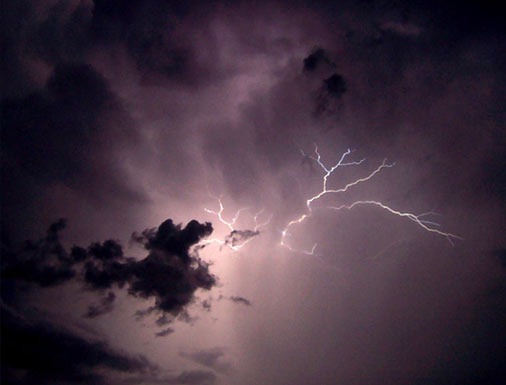
Random sheets of light explode from the sky, illuminating a chorale of fragmented hydrogen oxide.

One 1,000; two 1,000; three 1,000; four ...

Crackle ... boom!

---

We take for granted what we know.

We know that space and time are a matter of perception. We learned this in school. Or on "Nova."

How long did it take us to know?

It has been there for our understanding for centuries.

(Yet, we still call August the "dog days of summer," because the Romans were convinced that Sirius, known as the "dog star," added extra heat when it accompanied the sun during August. What would they say if we traveled back in time and tried to explain the tilt of a round planet that causes seasons?).

Flashes of light fill the void between us and the seeable things around us -- our clothes darkened with dampness, the steaming street, the raindrop precariously clinging to the tree leaf.

A few one 1,000s later we hear the rumbling sound of this phenomenon of the sky, where negative and positive energy collide and the heavens turn to fire. Or, if you prefer, God moves his furniture.

And it's that elementary:

This light flashed, a moment ago; this air rumbled and crackled, more moments ago -- but it all happened at once.

The light happened earlier because it happened faster. The sound happened later because it happened slower. Speed determines place, which time describes linearly.

We can see the mystery of space and time and E=mc2 from our front porches. Right there, during a thunderstorm, everywhere, always, as long as we've walked this planet.

Walked it slowly, and sped faster, and faster, until now we glimpse a miniscule awareness of eternity.

Saturday, August 19, 2006

Ballad For My One True Love


I always made such a fuss over her.

My beloved.

I was 8 years old. My Mom had sent me to a six-week-long summer camp for crazy children (even though I was quite level-headed ... then -- but, boy, were those kids crazy). Visitation wasn't allowed.

Mom spent that time galavanting around with a guy from Fort Lauderdale. When they came to pick me up from crazy camp, they told me they were getting married. A few weeks later, they were.

He was a Navy vet, a firefighter, and he had a tattoo of a flag of Fort Lauderdale with a heroin spoon as the flag pole. In short, he was like every other guy she ended up with (well, thankfully except for my Dad).

They took me on their "honeymoon" to (where else?) Fort Lauderdale.

I'd never been out of South Carolina.

We headed across the Everglades to Naples to stay with my uncle and do some fishing in the Gulf of Mexico. Everyone was catching something that day. Mostly Sheepshead.

I had spent that whole hot, August day in 1982 watching everyone reel in fish after fish as my pole stayed frustratingly motionless, except for the little teases that come with the steady up-and-down sway of the sea waves.

I was upset. I had a bad temper. The adults celebrated incessantly in some kind of Masters Of The Sea circle jerk.

Then, I felt my line tug.

And there she was. Into my life.

My beloved. The Ladyfish.

How beautiful her name sounded. So elegant and exotic, just destined to be hooked by a sawed-off, gap-toothed conquistador like myself. I, too, was a Master Of The Sea.

We took the picture and stuck it in the photo album.

---

For the entirety of my teenage years, I showed that picture to anyone who had eyes to see.

Me and the guys would finish our shift bagging groceries at the Winn-Dixie and head down to the farm pond to fish. We'd usually catch at least a largemouth bass, maybe more. Sometimes we came back with nothing. No matter, whenever I got back to the apartment, I could always open up the photo album and gaze upon my Temptress of the Gulf.

Every now and then, I'd be watching television by myself. I'd see the album. I'd open it up and just ... stare.

You might say she was my first love.

---

My uncle had moved up to South Carolina not too long after I reeled her into my heart. He had to cut out of Naples abruptly. The words you heard when adults talked and underestimated your ability to understand was that my uncle was fixing airplanes for drug dealers.

As I grew older, I never talked with him much. He liked guns and motorcycles (and pointing out the muffler burns that branded his calves and the scars of skin-ripped knee caps). He embraced a necessity of violence. He also had a big heart (as hardened as it was) and an obsessive sense of justice.

That's why he kept 15 dogs and 11 cats on his property. The number changed depending on what animal was found along the roadside or what animal had to be put down after hundreds of dollars spent on medication or surgery on any particular day. I never looked forward to negotiating a maze of electric fences to keep this dog from that dog because this dog doesn't like these three dogs and this one's in heat and ...

I never talked with the guy from Fort Lauderdale, either, because he had taken off back to Fort Lauderdale without us.

Then one day I was 19. I was in college. It was October. It was cold. My uncle called me up to tell me he had a boat and wanted to go out for a day of fishing on Lake Murray.

The last time I went fishing with him, it was warm, the water was Kool-Aid, you could stand on the coral reefs and cast your line and ...

I went.

---

We were freezing. The water was choppy. The fish weren't feeling it.

But there was a time when they were. When we were the gods of the Seven Seas.

When ... she ... came into my life.

---

Speaking of the biting cold (and not of near-tropical, summertime Florida breezes):

There's that moment in the Coen brothers classic "Fargo" where Marge Gunderson is driving in the cold Minnesota snow and realizes she's been lied to.

It's a striking scene: A homely pregnant policewoman from eventless Brainerd, Minn., staring through the windshield, letting it all sink in, in a sobering moment of betrayal.

She's on a fact-finding mission in Minneapolis to investigate the murder of a policeman and innocent motorists in her hometown.

Marge happens to meet a former high school admirer who -- in an attempt to get her to sleep with him -- tells her his wife died of cancer. She believes gives him her sincerest condolences. She calls a friend the next day who tells her that the woman who was supposedly his wife wasn't his wife and didn't, in fact, die of cancer. Even more, she could call her up and talk if she'd like.

It's on the drive back that Marge digests it all. People lie. That's what Jerry Lundegaard -- the bumbling used-car salesman unwittingly behind all the suffering -- did. He lied to her about a missing car that was registered to his lot and used during the killings.

She heads back to the dealership. This time, she's intent on the truth. The used-car salesman bolts and her persistent investigative work brings about a solution -- and a moral -- to the movie's tragic end.

---

Marge Gunderson was a believer who, through betrayal, became a more-dogged seeker of truth.

I was -- at the age of 19, on a cold, wind-torn morning -- a disbeliever who, through a lifetime of betrayal, became a dogged seeker of myths.

I didn't want to know about things. At least not any more than I already did know about things.

I just wanted ... her. My sweet, exquisite, sublime Madonna.

---

"Damn, Eric, these fish aren't biting."

"I know ... but, hey, you remember down in Florida? That Ladyfish I caught?"

"Ladyfish?"

"Yeah. On your boat, down in Naples. All day I didn't catch anything. Then just as we were about to head back, I caught that Ladyfish."

"Oh, yeah. I remember that. I caught that fish. We hooked it on your line so you'd feel like you did something."

He laughed and cast his line out.

I threw mine out, too.

The line tugged as the water shifted.

Sunday, August 13, 2006

Don't Do It, Bodangit


Call it The Diving Board Phenomenon:

Communities aren't building pools with diving boards anymore, because insurancewise they're too "high risk." In fact, hardly any are building pools with real deep ends these days, because even without a diving board, people still might try to dive into eight feet of water, and we all know that's suicide on a stick.

(Seriously. It's true. And, yes, I know the obvious question this raises: "When one of our friends goes a little crazy, like we all do sometimes, how can we say he went off the deep end if there's no deep end to go off anymore?").

South Carolina has been going off the deep end for centuries (first to secede, first in violence against women, first in drunk driving deaths, etc.).

But it's looking like we, too, will have to find a new way to put it.

For the better. For the worse. Depends on what history you bring with you and whether you're comfortable with that history.

Two icons of our impetuous defiance of the safe, the demur, the sober, the progressive, the subtle, the ... so not redneck ... are soon to be no more.

The Pavilion in Myrtle Beach and The Rapids in Columbia (one razed and replaced to cater to a higher-end taste, the other turned into a state park with tighter rules to diffuse anarchy and cater to a higher-end taste).

These places and I have history, and they have a few things in common:

* You didn't know exactly why you were there.

I was taken to them as rites of passage in my formative years, consumed them as a careless teenager as they consumed me, reached a phase of asking myself "How can I be such a backwoods dipstick?" and, finally, came to embrace them as the peculiar cubic zirconia jewels of "Where I'm From" that they are.

And now, I take my children to these kinds of places, seemingly oblivious that when they get old enough to go there on their own, I'm not sure I'd want them to.

* Extra "Cops" style drama to burn.

You were always five seconds away from the fight that wasn't a fight because nobody actually wanted to fight but felt like they had to act like they wanted to fight but then, every now and then, some guy decided to keep it real and ...

... or five seconds away from making a new best friend who, after only fifteen minutes of knowing you, would would take a bullet for you because you both liked that "House of Pain" song -- until he decided to hook up with the girl you were with. Then you wanted to fight.

* Life is potentially perilous.

I watched a dead guy get pulled out of The Rapids. People always got pulled out of there, because 1.) many of them are drunk and out of shape, 2.) the water's ice cold (even in August), the current's strong and no one seemed to realize that when the extremely loud siren is sounded that means the power company's going to unleash tons and tons of water from the lake dam and drastically alter the water level.

I could handle the current easily, but a friend of mine -- who was stronger than me but who suffered asthma and let panic get to him -- almost drowned. Thank Allah for kayakers, who were there for more-conventional activities and always seemed to be available to pull some drunk redneck out of the rushing water.

In Myrtle Beach a couple of weeks ago vacationing, I picked up the newspaper. There was a story about the 15th anniversary of the worst accident to happen at The Pavilion, when a pair of teenage boys rocking a car on the ferris wheel fell when the safety bar failed. One of the boys died. A girl they had clipped on the way down fell out, too, and was stuck upside down in the metal framing for quite a while before rescue workers freed her.

I looked at the story, and specifically the date, and then realized ... just a week before that happened, my best friend, Tommy, and I were in that ferris wheel. He was rocking the car, and I told him I was scared of heights. He told me he did it all the time. Of course, he also once tapped my window one morning when we were barely out of high school and took me out on his father's motorcycle at 105 mph down country backroads, then the tire blew out the next day before his dad could even get it out of the driveway (note to self: call Tommy again soon).

* People who are most important to me in my life have shared my history in these places.

My wife and I went to The Rapids in the first days of dating back in Fall of 1996 when we were in college together. The air was cold, and the water was colder, but I still stripped to my boxers and went for a swim.

My two little boys -- a full-day Pavilion pass wristband strapped on each of their hands, their faces dark and cheeks red and hair turned blondish by the beach sun -- spun in the nauseating Tea Cups, sucked down Icees and fought over who gets to the throw the ski ball in the arcade.

* I hate that both icons are being castrated, controlled, superdupermajorplansintheworkingified at the altar of making people who are afraid to be afraid to not have to be afraid.

Of anything -- whether it be tackiness, impending death or just people in general.

Yes, we're moving forward here.

And, somehow, I realize how it happens.

How these old-timers get to the point where they look at a parking lot and tell you incessantly about a tire swing that used to hang from an oak tree and the good 'ole days of feeling like you owned that place and, by extension, the entire world.

And then how we always just waited for our turn to talk, so we could get on to doing bigger and better things, which were the same things the old-timers were doing back in the old days, just in different places that hadn't suffered the same fate as the diving board.

Friday, August 04, 2006

Da Dud


The term "da bomb" officially belongs on the ash heap of outdated methods to try to explain your affection for something and at the same time try to sound cool doing it.

As in, "This Jack In The Box Spicy Chicken Biscuit is da bomb!" or "Jeff, you are da bomb for hooking me up with that Big Pun CD... it's, you know ... da bomb!"

(A common refrain for a person in my situation might be to say that I "hate people who say that." Actually, I hate people who say they hate people for saying things. Actually, no, I don't hate them, either. Hate is reserved for mosquitoes. Neither can I say they are gay. "Da bomb" isn't an indicator of sexual orientation. Let's just say ... it makes my eyes roll).

The problem isn't that the term is sooo '90s.

We still say "cool." That term came out before I was born some three decades ago. Or am I too old now and not cool enough to be an authority on whether "cool" is a cool thing to say anymore?

If so, that's cool.

Maybe today, bombs don't seem as "da bomb" as they used to be when it didn't feel like bombs were falling everywhere, all the time.

Maybe there's just something about "da bomb." You know, something ... about it.

Something desperate and dead-on-arrival when its use falls into the hands of middle-aged white dudes who finally bowed to the avalanche of cultural ridicule to cut their mullets and immediately grew goatees to harness the Samson-like power they crave.

Perhaps the argument is best made by something I heard while driving the other day:

During the work week, I don't listen to music when I drive. I'm working, I'm not myself, and I just want to hear people drone like the drone I am.

So, I listen to the local talk stations. Da bomb, they are not. Hackneyed, short-sighted and rife with sycophants. NPR comes on in the morning (and the word "morning" and I don't agree, because it's not da bomb, either). And the public radio station can't seem to shake playing nothing but bluegrass music all day long.

The sports station is full of talk about my Gamecocks' hated arch-rival and its second-generation missing link following, nearby Clempson University. So, I listen to the "news" station, which is best described by the same example I use to describe "da bomb."

They're doing promotions for their station, playing soundbites of callers talking up the station's attributes. Chiming in with "opinions," otherwise known as "huge stinking anal secretions."

A guy with a thick, deep-woods accent pops up. It's the voice that you hear that you can't distinguish from the other voices that are usually talking about banal things like how they hate the fact that girls' skirts are so short these days.

For right now, he's talking about how da bomb the station's weather guy is.

"Man, you are da bomb!" he screams.

Which leads me to an interesting and unexpected conclusion: Somehow he and the rest of these people who help remind me how dead I am inside while on my drive home from work ... they are da bomb.

And that doesn't mean what it used to.

Monday, July 31, 2006

So, Where Do You Like Your Pancakes?


To drive the neon-flashing boulevards of Myrtle Beach is to embark on a journey of hyperstimulation and information overload.

There are so many signs. Just as there are so many businesses that offer the same products and services.

Within each mile of the main business stretch of this so-called "Redneck Riviera" (or, as I like to call it, "Daytona Tweaking On Meth") you are guaranteed to see at least one of each of these establishments:

... An obscenely oversized bargain beach store where you can buy bathing suits, shark-tooth necklaces, temporary tattoos and t-shirts with the silouhette of a stripper and "I Support Single Moms" scrawled in big letters.

... An obscenely oversized "Calabash" seafood buffet restaurant that offers the same atmosphere a discerning dining connoisseur would find in pigs gathering around a horse trough.

... A "gentleman's club" that promises the best women and offers (sadly) a lunch buffet.

And ...

A pancake house.

These places are desperate for our attention. They struggle to stand out from the pack -- like the homogenous beach dude banking on the hope that all those wintertime crunches will have his abs blaring the loudest.

(They don't understand the sublime simplicity and unassuming charm of the Qwik Mart, by far my mostest favoritest sign in all of known creation).

Alas, the beach stores and the buffet restaurants and gentlemen's clubs rely on neon. The strategy is to brainwash you into believing you're a moth: The brightest light wins.

For whatever reason, the pancake houses can't quite pull off the neon. So they employ a more-subtle device, one that's more insidious than intrusive.

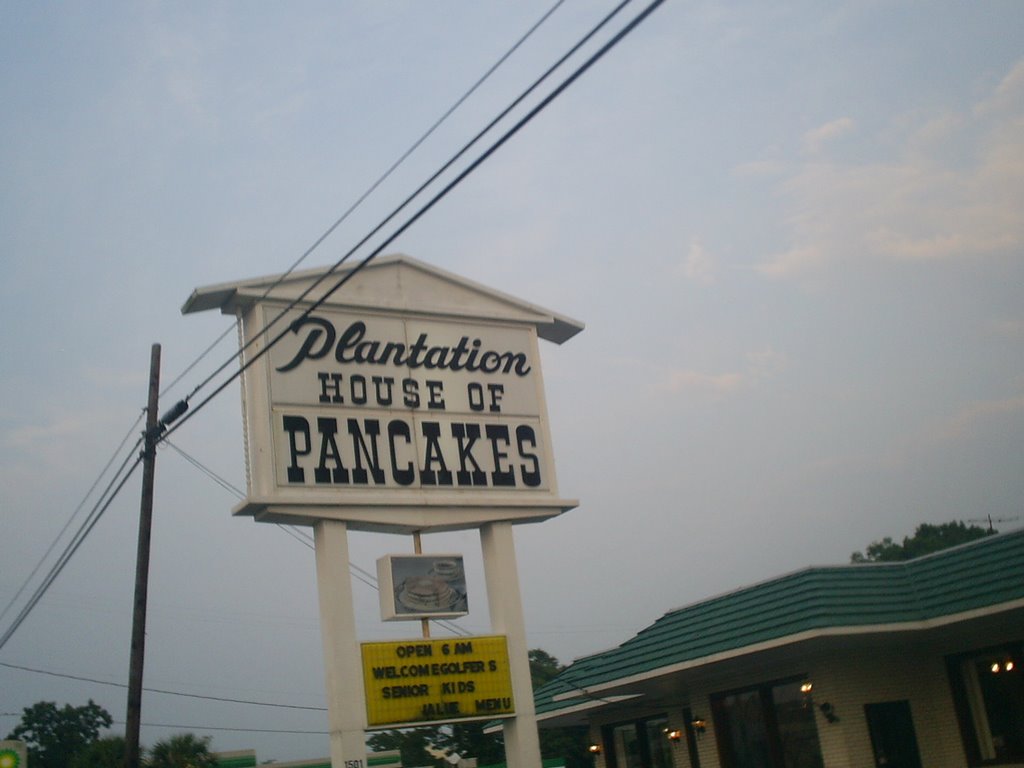
This must be my favorite pancake place (even though I've never eaten there):


I love it simply because it's mere yards from this place:


Not to be outdone, this one is directly across the street:


Yes, the key is to establish your area of coverage. It's kind of like how professional sports teams try to claim a region instead of one mere city (the Carolina Panthers in Charlotte, the Florida Marlins in Miami, the ... yes, this is actually their name ... the Los Angeles Angels at Anaheim).

I'm not sure which ensures the best pancakes: Those pancake houses that claim pre-eminence over large regions or the ones that devote themselves to smaller coverage areas.

You can find just about any directional-style pancakes you wish:


Not too ambitious. Just some acreage.

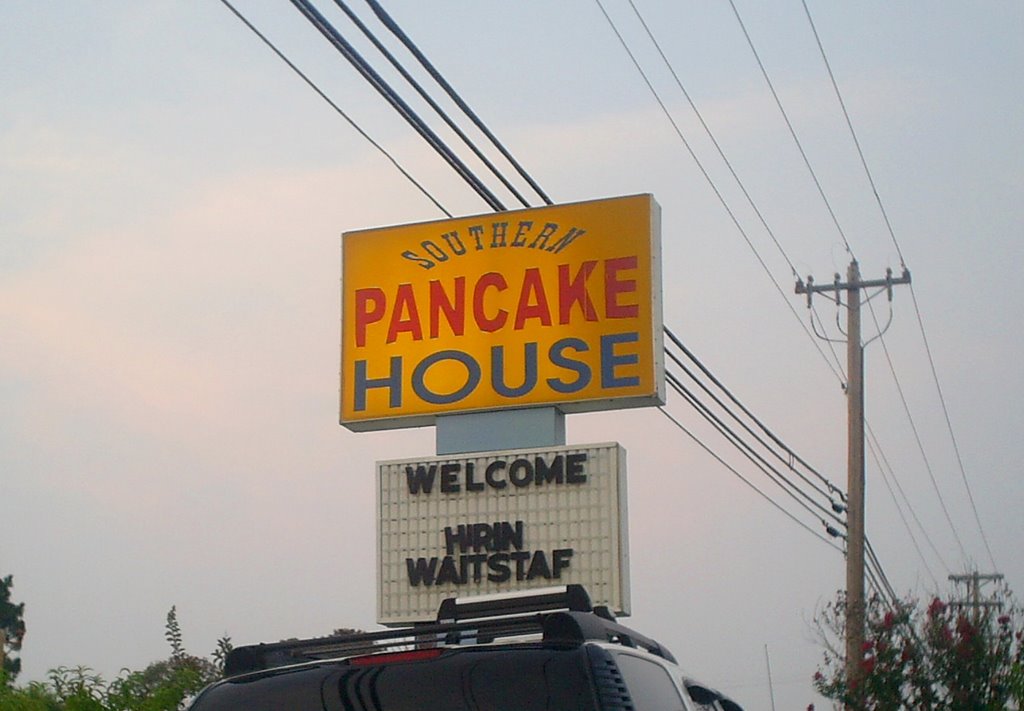
This one aims a little higher:


Perhaps the most directionally appropriate given the locale (and, appropriately, "HIRIN WAITSTAF").

But certainly eclipsed in the shadow of:


It doesn't claim international hegemony -- just dibs on, I suppose, the North and South American continents.

So, the standard-bearer of pancake houses -- International House Of Pancakes -- is the one with the largest geographical claim.

Which leads me to wonder:

Should I open a Global House Of Pancakes, which would incorporate the seven seas and the continent of Antartica, which isn't a nation?

A Milky Way House Of Pancakes? Intergalactic House Of Pancakes?

No, I think I've got it: Omniversal House Of Pancakes.

Beat that, IHOP.